


The Reckoning: Spy Lesbian Romance (Signed Paperback)
The Reckoning: Spy Lesbian Romance (Signed Paperback)
Nail biting sapphic thriller!
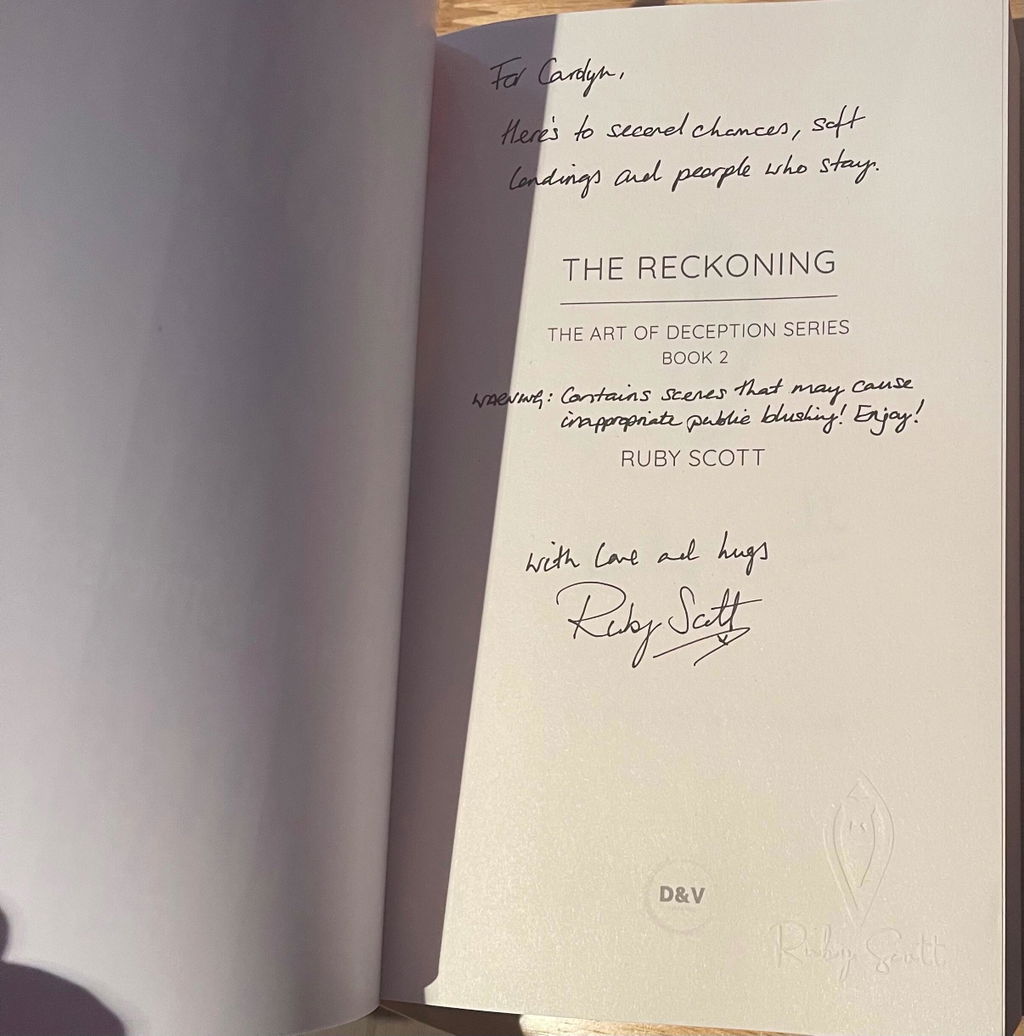
To add your name, dedication, or a special message to the inscription please email ruby@rubyscott.com quoting your order number.
Couldn't load pickup availability
BOOK TWO IN THE ART OF DECEPTION SPY LESBIAN ROMANCE SERIES.
A high-stakes spy lesbian romance thriller featuring deadly secrets, dangerous women, and a reckoning years in the making.
She spent thirty years as Moscow’s weapon. Now she’s pointed at them.
Suzette Conner-Wakeman knows how to make people disappear. She did it for the Russian government for decades, until she walked away, trading the shadows for a vineyard, a wife she refuses to lose, and the illusion of peace.
But peace never lasts.
When thirty refugee women vanish into illegal drug trials, no one is looking for them. No one is asking questions.
Suzette does both.
What begins as a rescue becomes a war. Against traffickers. Against a powerful pharmaceutical empire. Against the very system that created her.
Because the past is not finished with her.
Old lovers return with unfinished business. Allies fracture under pressure. And the line between strategy and seduction begins to blur in ways that could cost everything.
To save the women no one else will fight for, Suzette must decide how much of the weapon she used to be she is willing to become again.
And whether love can survive what comes next.
A white-knuckle lesbian spy thriller where the tension runs high, the nights run hot, and the reckoning comes for us all.
Tropes and themes
- spy lesbian romance
- sapphic romantic suspense
- morally grey lesbian characters
- espionage lesbian romance
- high stakes lesbian thriller
- second chance lesbian romance
- action thriller lesbian
This book is for you if you love:
- high-stakes spy thrillers with powerful women
- morally grey heroines with complicated pasts
- tension-filled stories where loyalty is never certain
- character-driven lesbian thrillers with emotional depth
If you are searching for a lesbian spy thriller packed with tension, action, and emotional stakes, The Reckoning delivers a gripping, high-stakes story where every choice has consequences.
Continue the Art of Deception lesbian thriller series
If you love high-stakes lesbian thrillers with danger, desire, and powerful character arcs, start with:
Each book explores power, deception, and the cost of survival in a world built on secrets.
More lesbian romance by Ruby Scott
If you enjoy slow burn lesbian romance and emotionally intense relationships, you may also love:
- Mistress of Desire – an erotic lesbian romance with dominant women, power dynamics, and emotional intensity
- No Way Out – a psychological lesbian thriller featuring a closed-circle mystery and deadly secrets
- Healing of the Heart – a deeply emotional medical lesbian romance featuring an ice queen surgeon and a powerful connection
Each copy is personally signed by the author and includes a one-of-a-kind inscription written just for you. Your book is beautifully wrapped by hand and presented in a gift box with a few extra treats inside, making the entire experience feel as special as the story itself, from the moment it arrives to the moment you turn the first page.
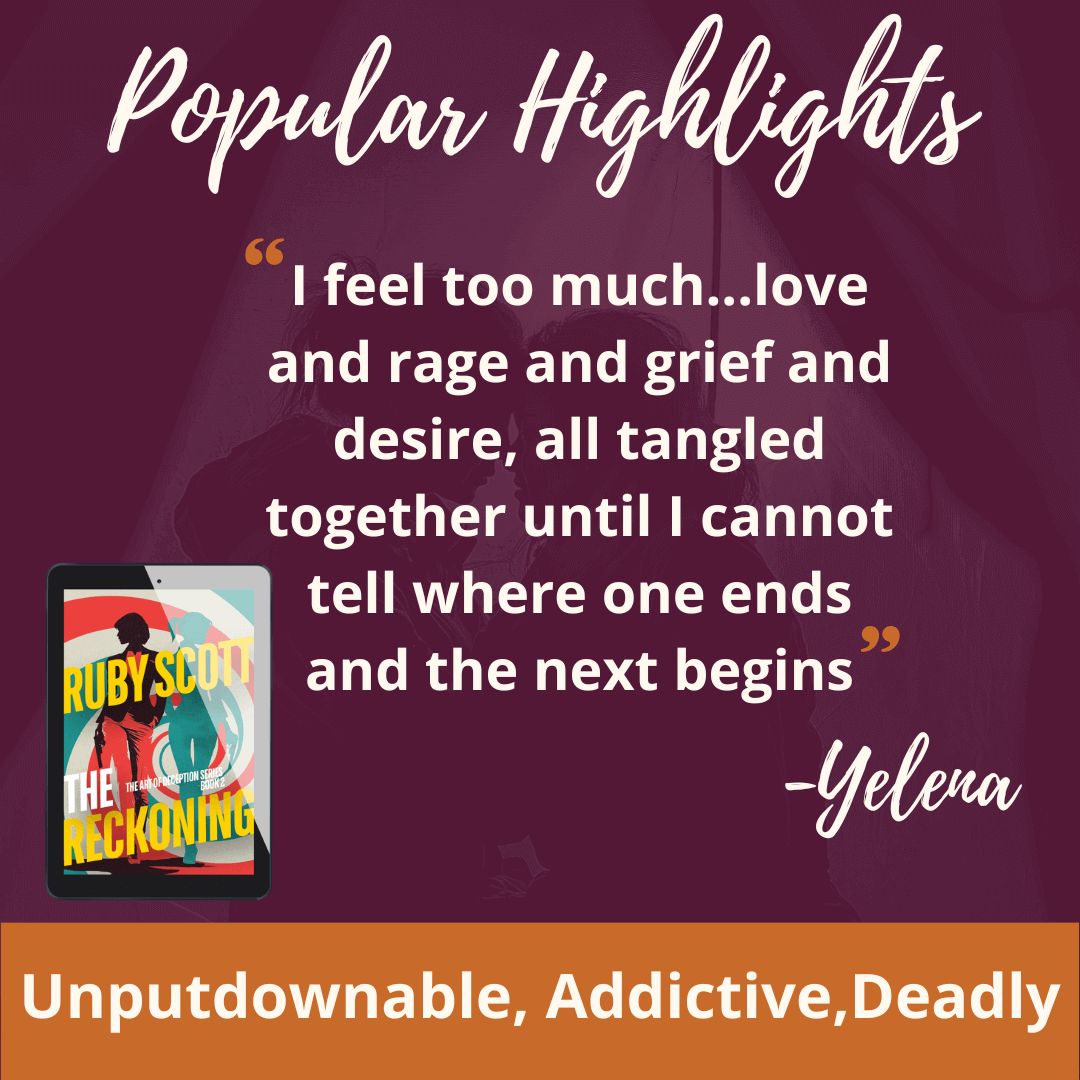
⭐⭐⭐⭐⭐ "I started at 10pm. Finished at 4am. So worth it!" ⭐⭐⭐⭐⭐ "Suzette Conner-Wakeman could ruin my life and I'd thank her."
Signed books are dispatched from Scotland within 7- 10 business days using a tracked and insured postal service. Please provide a phone number with your shipping address as some couriers require it.
Shipping times vary per location. Depending on your location import duties, fees and taxes may be charged by your courier on delivery.
Book Specifications:
Book Specifications:
Pages : 508
ISBN : 9614622000600
Weight : 478g
Dimensions : 127 x 28 x 203 mm
Full Description
Full Description
Suzette Conner-Wakeman knows exactly what she is.
Thirty years as Moscow's weapon taught her how to seduce, manipulate, and kill without hesitation. She did things that still surface in nightmares. Then she walked away. Found Amber. Built a life from the wreckage: a vineyard, a marriage, a family of former operatives bound by loyalty fiercer than blood.
She thought she'd buried the monster for good.
She was wrong.
When intelligence lands on her desk showing refugee women disappearing into illegal pharmaceutical trials, Suzette can't look away. These women have no papers. No family asking questions. No one who'll notice when they stop breathing. They're being pumped full of experimental drugs, their bodies used up until there's nothing left to use.
The men running this operation have money. Political protection. Ties to the Kremlin that make them untouchable.
They've never met Suzette.
She assembles her team. Amber, her wife. Former Spetsnaz. Still the most dangerous woman in any room and the only one who knows every scar Suzette carries. Victoria and Abby, civilians pulled from charity work into a war they never trained for. Hackers who can crack any system. Operatives who owe Suzette their lives.
But the cracks appear almost immediately.
Yelena surfaces. Suzette's oldest rival. Her former lover. The woman who once held a gun to her head and kissed her in the same breath. She's carrying secrets that could change everything, and the heat between them never died.
Then an operative goes dark. Intelligence leaks. And Suzette realises the enemy isn't just outside her walls.
But is someone in her family is a traitor?
As the conspiracy unravels, reaching into the highest levels of government, Suzette faces an impossible choice. To save the women no one else will fight for, she must become what she buried. The seductress. The killer. The version of herself that feels nothing and stops at nothing.
But resurrection has a cost. And before this war ends, blood will spill that Suzette cannot afford to lose.
The women are running out of time. The traitor is closing in. And the reckoning Suzette set in motion is about to consume everything she loves.
Some monsters don't stay buried. Some prices can't be unpaid.
Themes and Tropes
Themes and Tropes
- High Heat
- High Stakes Suspense
- Dangerous Women
- Found Family
- Ex-lovers with Guns
- Forced proximity
- Protector Romance
- Morally Grey Heroines
- FF and FFF
Chapter One Look Inside
Chapter One Look Inside
CHAPTER ONE
SUZETTE
My father taught me to catch things he threw when I was seven. Knives, mostly, aimed towards my head. Later, grenades, pins in or out, depending on how good a day he had experienced.
Today it's just a soup spoon.
It hits my palm before my brain registers movement. His fingerprints on my reflexes. The splash of accompanying brown, almost purple liquid tells me everything I need to know. Borscht.
He hates beetroot. But he loves anything sweet and I know he'll be coveting the half-melted ice cream in the adja-cent bowl.
“Still fast!” he says from his chair by the window.
“Still alive?” I ask, unable to hide the edge of disappointment. The man in front of me might be breathing but confirming Colonel-General Volkonsky's beating heart has always been a challenge and none more so than now: weathered and wizened with almost translucent skin, he is the husk of the bronzed god he once was.
He slides the dessert bowl in front of him and looks at me expectantly.
I set down the spoon, his only utensil, just out of his reach.
Room 32B smells, like the rest of the home, of aged boiled cabbage and lingering death. The walls are a shade of cream that starts dingy and worsens by the pollutant breathing of its residents. Rectangular shadows line where previous occupants hung framed memories of hope and family, before my father moved in. A single bed with metal rails dominates the room next to a nightstand bolted to the wall. A television mounted too high for comfort, silenced, sends animated shadows across the room. There are no personal effects beyond a folded copy of Izvestia, an unopened letter on a small table, a photograph face-down on the windowsill.
“I didn't want you to visit. I didn't ask you here.” He looks away, his gaze now set on the large bay window and the gardens beyond—his once larger-than-life persona now hollowed out, much like the charisma and sex appeal he used to brandish like a weapon. What remains carries the faint whiff of stale ammonia, decay dressed up in bleach. But underestimate the man at your peril. He's still as lethal. “You chose to come. Why?”
“I don't know.”
“Liar.” His eyes narrow, and even through the creases he still looks dangerous—pale grey, cold and murky like well-trodden slush. “You always know. You're too calculating not to know.”
He's right.
The last time I saw my father was the day before he signed the papers to process my elimination. Eight years ago, in a windowless room in Lubyanka. Today, in this mock Tudor mansion in the arse-end of Nasty, an aptly named Hertfordshire hamlet where the government contains intelligence liabilities by removing their walkers, I wonder if he might try to complete what he failed to do before.
He spins his recliner, turning himself to face the small table holding his folded copy of Izvestia, and an object he palms before I can identify it.
“They feed us well here,” he says, conversational. “Three meals. Medical care. Entertainment.” He stands, placing his hand on a cabinet for support, the wood veneer peeling at the corners like sunburned skin, and I see what he's holding.
A letter opener. Brass. Eight inches. Sharp enough.
The overhead light catches it as he turns it in his hand, throwing small coins of reflection against the murky walls.
“All the retired officers together, remembering the camaraderie of the glory days.” He nods to the bed. “Sit.”
I remain standing. Habit—never give him the high ground, even if it is symbolic.
His mouth curves. Not quite a smile. “Still cautious. Good. I taught you that at least.”
“You taught me many things.”
“Yes. Most of them against your will.”
Outside, November drizzle streaks the window. The gardens beyond are bare: pruned roses waiting for spring that may never arrive, a birdbath crusted with algae, wooden benches rotting into the lawn. Nothing grows here. Every-thing just waits to die with or without dignity.
“This is prison with better food.” He moves closer, casual, testing. “But then, you understand prison. You've built your own. Marriage. Vineyard. Pretending to be French. As if new name erases who you are.”
“It's called moving forward.”
“It's called running.” Another step. The letter opener catches light from the window—weak, watery, English light that never quite commits to being anything. “From me. From Moscow. From everything I made you.”
My weight shifts automatically. Left foot back, right forward, balanced. He notices and smiles—pride, almost.
“There she is. Aleksandra. My bastard child. Trained to kill, trying to play civilian.”
“I'm done killing.”
“No one's done killing.” He's close enough now his smell is stronger. Wood-spiced aftershave fighting a losing battle against age and entropy, the metallic tang of medication, sour and sharp underneath. He's close enough that I could disarm him in two moves. He knows this. Wants me to know he knows. “It's in your blood. In your training. In every reflex you can't control.”
The letter opener flicks toward my throat. He’s not testing anymore, but attacking, speed surprising for his age.
I'm not there when the blade arrives. I'm to his left, his wrist in my grip, twisting, pressure on the nerve cluster that makes his hand spasm open. The letter opener clatters to the linoleum, cheap, institutional flooring chosen for ease of cleaning blood and other bodily fluids.
We stand frozen, me holding him in place, his breath ragged and whistling through what might be early-stage emphysema.
“Good,” he says softly. “Very good.”
I release him and step back, heart pounding, rage building. “What the fuck was that?”
“Proof you're still my daughter.” He retrieves the letter opener like nothing happened and returns it to the table, hands steadier now, as though violence has rejuvenated him. “You can change names. Countries. Identities. But when someone attacks, you respond. Without thought. That's mine. I gave you that.”
“You gave me trauma.”
“I gave you survival.” He sits again, suddenly looking exhausted, as though the brief surge of energy has evaporated, leaving him empty. “The world is violent. Pretending otherwise gets you killed. I prepared you.”
“You tortured me.”
“I trained you. There's difference.”
I move toward the door. This was a mistake. He isn't going to give me what I want.
His voice stops me.
“Sit.” He sighs. “Please.”
The please is so unexpected I turn around.
He's not looking at me anymore. His gaze is out far past the confines of this room, through the rain-streaked window to something I can't see—Moscow perhaps, in offices where decisions were made, in rooms where men like him shaped the world by fear and coercion.
Against better judgment, I sit on the edge of the bed. The mattress is hard, wrapped in a waterproof covering that crinkles when I shift my weight.
Silence stretches. Outside, a crow lands on the windowsill, regards us with one black eye, like a judge weighing evidence, then loses interest.
“I need to know where she is,” I say.
He doesn't ask who I mean. Just reaches for his tea with hands that shake more now given his unnecessary exertion. A fine tremor, the sort that comes from age or Parkinson’s or decades of decisions that won't stay buried. The tea looks lukewarm at best, a greasy layer formed on the surface, in a chipped mug with the home's logo—a tree that's supposed to represent longevity but looks more like it's being struck by lightning.
“You think so.”
“Yes.”
“And you believe I know this?”
“I know you know. You've always known. You just chose to keep it from me.”
He sips his tea. Sets it down with exaggerated care, as though sudden movement might shatter more than porcelain. “Why I would tell you now?”
“Because you're dying. Because secrets die with you unless you share them. Because—” I stop. I won't beg. I've never begged him for anything and I won't start now.
“Because you think I owe you.” He smiles. Actually smiles. Teeth yellowed by decades of cigarettes and tea, one incisor chipped from a bar fight in Berlin circa 1987. “This is sweet. Delusional, but sweet.”
“You owe me nothing. But you have the information I need.”
“Information.” He turns the word over like a diamond dealer searching it for defects. “So clinical. Is this what she is to you? Information to be acquired?”
“Don't.”
“Don't what? Point out you are treating her like intelligence objective?” He laughs—a dry, bitter sound like paper tearing, or frozen ground cracking under boots. “I taught you too well.”
“Where is she?”
“Why do you want to know?”
“That's my business.”
“No, Aleksandra. You came to me. You made it my business.” He leans forward, and for a moment I see the man the colonel-general used to be—sharp, strategic, dangerous. The man who planned operations across three continents, who decided which assets lived and which became acceptable losses. “So tell me. Why? After all these years. After walking away. After building your little life in France. Why now?”
I could lie. Should lie. But he'll know.
“Because I need to find her. Because I've tried everything else. Because you're the only person left who might actually know.”
“Might.” He savours the word like expensive vodka, rolling it around his mouth. “But might is not certainty, yes? You are gambling. Coming here. Exposing yourself to me. Hoping I will be generous in old age.”
I could point out the bridges he's burned with Moscow, the precarious situation he'd be in if the Kremlin learned of his continued existence. But getting what I want won't be born from threats. Blunt force won't work.
“Will you?” I ask.
“No.”
I grind my teeth against the verbal slap.
“Why not?”
“Because she is better off without you.” He says it simply, with his natural casual cruelty, the same tone he'd use ordering coffee or signing execution orders. “Whatever you think you need from her, whatever closure or redemption or reconciliation you are seeking—she does not need this. She does not need you. Never did.”
“You don't know that.”
“I don't?” He moves to the window. The crow is still there, preening wet feathers. He taps the glass and it flies away, leaving small scratches on the sill from claws that have seen worse perches. “I know more than you think. I know where she is. What she does. Whether she is happy. Whether she thinks about you.”
My chest tightens. “And?”
“And nothing.” He turns, backlit by the grey early winter day filtering through clouds like old dishwater. “You're irrelevant.” He laughs. My fists tighten as I force them down by my sides. “I won't allow you to play out this ridiculous midlife crisis seeking redemption by destroying my legacy.”
7
“That's not—”
“This is exactly what you are doing. Selfish. Self-serving. Wrapped in pretty language about closure and truth, but you are as self-centered and pitiful as you have always been. Me, me, me…”
I stand. “You're wrong.”
“Am I?” He moves closer—slow, deliberate, like he's crossing a minefield he planted himself. “Then tell me. What happens if you find her? If you show up and she wants nothing to do with you? If she is happy where she is and you are reminder of things she would rather forget?”
“Then I'll respect that. But it should be her choice. Not yours. Not Moscow's. Hers.”
He lets out another huff of laughter. “Bold words from someone who removes others' choices without second thought.”
I flinch. He sees it and sneers. “Besides I cannot tell you. I made promise.”
“She asked you to hide her from me?”
“Not her.” He sits again, skin hanging loose on his frame like a suit bought in better times. “Someone else. Someone who cared about her welfare more than they cared about your feelings.”
“Who?”
“This is not information you are entitled to.”
I move toward him. Fast. He doesn't flinch.
“Tell me.”
“Or what? You will hurt me? Please. I am dying anyway. Save yourself effort.”
“I could make it hurt more.”
“You could.” He meets my eyes, his pale grey to my dark brown, winter to earth, ice to blood. “But you won't. Because you are hoping I will change my mind. Hoping if you are patient, or persuasive, or pathetic enough, I will give you what you want.”
He's right. I hate that he's right.
I step back.
“I'm getting my files. All of them. Unredacted,” I tell him. “I'll find out everything I need.”
“Then why you need me?”
“Because the files will tell me where to hunt—you can tell me who to hunt.” As much as I hate the confession, with his help I can exact my revenge faster. I watch as smugness curls the corners of his mouth, and then I realise why. “But then the information I need never made it into the files, did it?”
A malicious glint makes his eyes sparkle like broken glass catching light. “I could give you what you want but why I would do that? You are intent on burning down my life's work and I won't let you.”
“Your life's work?” I pull open the wardrobe door with its full-length mirrored façade, the silver clouded with age, spotted like diseased lungs, and show him his reflection.
Sunken eyes stare back. Grey skin stretched over bones that show too clearly. A face more gaunt than chiselled, cheekbones sharp enough to cut. The man who once commanded armies reduced to someone who needs help opening medicine bottles. His pyjamas hang off him, prison stripes in pale blue and white, generic sleepwear chosen by committee to offend no one and comfort even fewer.
He looks away quickly, but not before I see his expression crack.
“The only reason you're still revered in Moscow is because they think you're dead! And you might as well be.” I gesture to the room, the medicinal supplies, the call button, the wheelchair folded in the corner waiting for the day his legs give out completely so it can replace his recliner. “They've imprisoned you here, just waiting for you to die. The glorious Colonel-General Volkonsky, grateful to be hidden away in a dementia home for the all-but-dead.”
A shudder runs through him, as though wincing at the truth, a crack in the starched uniform he's worn so long it's fused to skin. But then he rounds on me, and for a moment the dying man disappears, replaced by the soldier, the spy who took lives with the flourish of a pen.
“And you cannot change this. MI6 will not allow you. I am an asset. I have value.”
“For now,” I say.
But I intend to change that.
The rain picks up outside, drumming against the window like fingers tapping for entry. The room darkens as clouds thicken. Somewhere down the corridor, someone is crying— high, keening sound that might be pain or confusion or just the sound of realising you're still alive when you'd rather not be.
I move to the door.
“She does not need you,” he says to my back. “She never did. Whatever fantasy you are chasing, it ends badly. For both of you.”
I don't turn around.
“Maybe. But as I said, that's her decision to make. Not yours.”
“How many choices have you made for others?”
His laugh follows me into the corridor, dry, bitter, yet triumphant somehow. Like he's won simply by losing, forcing me to prove I'm still what he made me.
The corridor stretches ahead. Motivational posters about dignity. Watercolour landscapes chosen to be inoffensive. A resident in a wheelchair by the window, staring at rain-soaked gardens where nothing grows.
This is where powerful men end up when they know too much to be killed but too much to be free.
This is the retirement plan for people like my father.
And maybe, if I'm not careful, for people like me.
I sign out at reception. The nurse barely glances up from her computer, already forgetting I'm here. Buckthorne Manor. A name designed to comfort families who need somewhere to warehouse the inconvenient—and a government that needs somewhere to hide the dangerous. Mock Tudor beams that have never seen real timber. Carpets worn to grey thread at the corridor's end where the overhead light flickers with an almost Soviet determination to fail without quite dying.
Outside, the rain is cold and English and relentless. My rental sits in the visitors' car park between a Nissan whose bumper is held on with duct tape and a Volvo that's older than me.
I sit in the driver's seat without starting the engine.
My phone shows three missed calls from Amber. One from Phillipa. Tomorrow I'm supposed to meet with Victoria Fraser, discuss some proposition Phillipa thinks I'll find interesting.
But tonight I'm sitting in a nursing home car park in Hertfordshire, shaking, because my father knows where she is and won't tell me, and the only weapon I have left is the one he gave me, patience, strategy, and the willingness to do what needs doing even when it costs everything.
I start the engine and drive away from Buckthorne Manor, watching it shrink in my rearview mirror, full of people already forgotten.
Behind one of those windows, my father is sitting in his chair, smiling, knowing he's won this round.
But the game is far from over and it won't be until one of us is dead.
Share


From page one this book moves. Like foot-on-the-gas don’t-blink-or-you’ll-miss-something moves. I was not bored for a single second and between the relentless plot momentum and the generously sprinkled spicy scenes there was absolutely no chance of that happening anyway.
I’m usually a full romance girly but this action suspense thriller had me completely hooked from start to finish. It’s sharp tense and wildly addictive in a way that makes you promise yourself just one more chapter and then suddenly it’s 2AM
I loved getting more time with Suzette and co. We already learned a lot about Suzette’s past in the previous book but this one digs even deeper and I really enjoyed how Ruby explored that history. She has a real talent for taking characters who have been through the kind of trauma that should leave them broken beyond repair and instead letting them become powerful unstoppable incredible women. That always hits for me.
Seeing “the family” in full crisis mode was another highlight. The dynamics really shine under pressure and it made everything feel more real and grounded. Victoria and Abby especially added so much and helped balance out the high stakes spy energy with very human moments.
Honestly the only downside is that I am happily married and monogamous because after finishing this book I also kind of want to join the family
Thank you so much for this incredible review.
'Foot-on-the-gas, don't-blink-or-you'll-miss-something' is exactly the energy I was aiming for with The Reckoning, so I'm delighted it worked for you.
I loved writing Suzette's journey in this book. She's been through so much, and exploring how those experiences shaped the woman she became was one of the most rewarding parts of the story.
I'm also thrilled you enjoyed seeing the family under pressure. There's something about a crisis that reveals exactly who people are, and I loved watching Victoria, Abby, and the rest of them rally together when it mattered most.
And as for wanting to join the family... honestly, I think that might be one of the highest compliments The Reckoning could receive.
Thank you for reading, for sacrificing sleep, and for taking the time to leave such a thoughtful and generous review. It means a great deal to me.
This book is so good I’m already on my second read through. I’m excited to see what book three brings.
Thank you so much for this wonderful review.
I'm delighted The Reckoning has already earned a second read through. There are few compliments an author values more than knowing readers want to return to a story they've already finished.
I'm so pleased you enjoyed the mix of suspense, emotion, and heat. Those are always some of my favourite ingredients to write.
And trust me, I'm just as excited for Book Three as you are.
Thank you for reading, rereading, and for taking the time to leave such lovely feedback. It means a great deal to me.
This book is a masterclass in suspense. It flung me across every point on Plutchik’s Wheel of Emotion—fear, joy, shock, grief, anticipation—before landing on a happiness so hard-won I’m still clutching it with both hands!
A perfect follow-up to The Turning, The Reckoning doesn’t just meet expectations—it raises the bar and then sets it on fire! This is Ruby Scott at her absolute best, delivering more of everything that made me fall in love with this world: more tension, more intrigue, more jaw-dropping twists, more character development, and yes… more spice! (Chapter 16 alone nearly took me out—my hot flushes can personally vouch for that!) 🥵
In short, I fucking adore this book! I love this world, the layered, interwoven storylines, the emotional depth of the characters, and the wild, unforgettable journey it took me on. Ruby Scott, consider me emotionally wrecked and begging for more!
Thank you so much for this incredible review.
I have to admit, 'UnFLUSHing Believable!' may be one of my favourite review titles ever.
I'm absolutely delighted The Reckoning took you on such an emotional journey. Making readers laugh, worry, gasp, cheer, and occasionally question whether they should be reading Chapter 16 in public is exactly the sort of experience I hope to create.
Hearing that the book not only lived up to The Turning but raised the bar for you means more than I can say. This world, these women, and the family they've built have become very dear to me, so knowing they resonated so strongly with you is incredibly rewarding.
And 'emotionally wrecked and begging for more' sounds suspiciously like the exact state I was aiming for.
Thank you for reading, for caring so deeply about these characters, and for taking the time to leave such a thoughtful, hilarious, and generous review. It means the world to me.
Want exclusive chapters, spicy extras, and 10% off your first order?
Join The Ruby Collective — my private list for lesbian romance readers who want more heat, more heart, and early access to every new book.
- Choosing a selection results in a full page refresh.
- Opens in a new window.